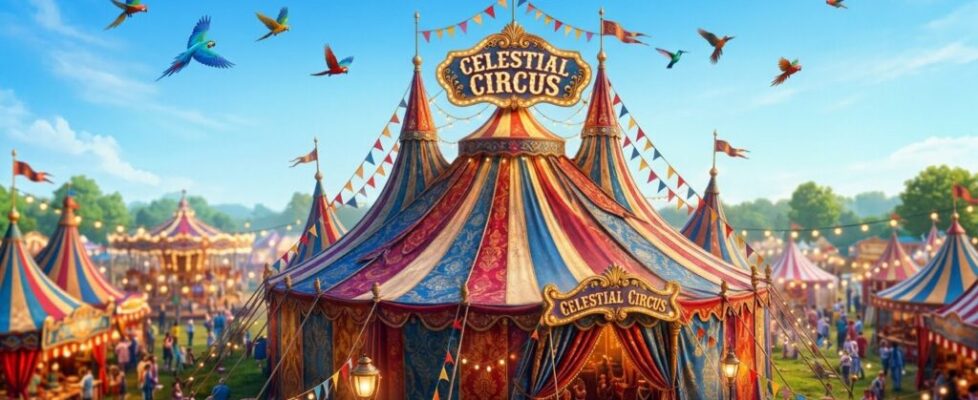
Cirque de Oiseaux
Last week I spent a joyful morning in Croton Point Park, one of my favorite places to wander.
It was the first calm, sunny day after the big Nor’easter, which blitzed the entire region with strong winds and drenching rain. And after days of hunkering down, the birds were clearly eager to escape from their shelters, stretch their wings, and…perform.
I spent a couple of hours watching the lawns around the nature-center hill; the willows, oaks, and other trees scattered across the grass; and the edges where the hill’s forested slopes blend with patches of jewelweed, vines, and various bushes and shrubs. At nearly every moment during my time there, there was so much going on—so much activity—that I was left feeling both dizzy and exultant.
Activity? No, I’m not talking about spectacular breeding displays like the ones Birds of Paradise engage in.
No, what I was seeing was behavior of a more typical, everyday sort. The way each species showed its character and personality, how it moved, fed, existed (and coexisted) in the world.
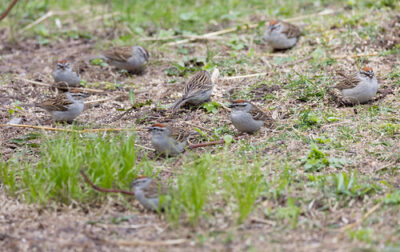
For the first time, I noticed that Chipping Sparrows tumble. Flocks of these tiny birds—six or eight at time—came flying down from low branches and swirled to the ground like autumn leaves in a strong breeze. Then they’d rush around the short grass searching for seeds before tumbling upwards again, tiny acrobats on effortless wings.
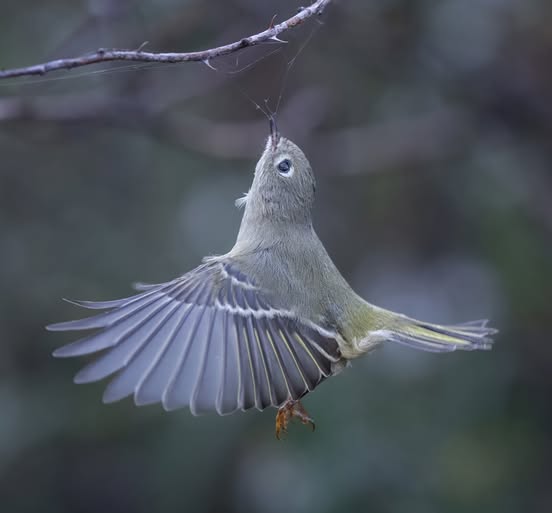
Ruby-crowned Kinglets flit. I watched one dart from branch to branch, never sitting still for more than an instant before arrowing to its next sunlit perch. Given the Kinglet’s minuscule size and nearly circular shape, its totally unpredictable movements reminded me of a pinball bouncing between flashing bumpers in a sideshow arcade.
Eastern Phoebes and Palm Warblers wag. Their tails, that is. The Phoebes, handsome little flycatchers, wagged especially fervently whenever they landed or changed position on a perch, while the warblers never stopped, whether they were ranging across the lawn or perching on low branches above it.
Why do these species wag? Theories abound: Maybe it’s to help with balance (much the same way that circus tightrope walkers, not gifted with tails, use long poles), or to let potential predators know they’re awake and alert, or to startle insects into view, making them easier to find and snarf up.
No one knows for sure. What I did know was that, after watching them through binoculars for a while, I began to feel seasick and decided to look elsewhere.
I shifted my gaze down to a patch of unmowed lawn not far from me. There I glimpsed a group of brownish forms moving quickly towards me through the tall grass.
For one heart-stopping moment, I thought I was being attacked by a pack of rodents. Then I got a better look…and that’s when I learned that Brown-headed Cowbirds both scurry and hop. They were the clowns of the morning’s show, sneaking through the grass and occasionally making a comical leap a foot off the ground (to see better?) before racing onward, helter-skelter.
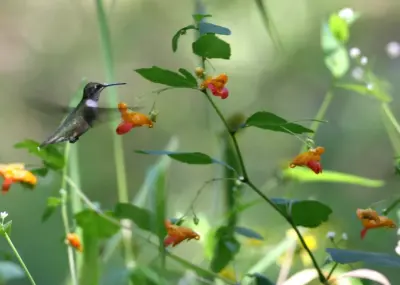
These were far from the only birds I saw during my visit. Half a dozen Eastern Bluebirds sang and called, providing musical accompaniment to the spectacle. Ospreys and a Bald Eagle flew overhead, looking down on us with complete disinterest. Blackpoll, Northern Parula, and Magnolia Warblers foraged in the trees, while a Ruby-throated Hummingbird zipped around the jewelweed. Each added to the whirling, never-stopping movement that left me with no clue where to look next.
As I finally pulled myself away (I did have other things to do), I found myself thinking about what about birding makes it such a fulfilling pursuit for me…and what doesn’t. Too often, I think, I just keep moving, seeking a big list, never looking at any bird for longer than it takes to identify it. Worse, sometimes, rather than giving a bird more than a glance, I wait till I get home to study photographs of it.
But my morning at Croton Point reminded me that there is so much more to birding than making a quick ID, compiling a big list, or capturing a telling image. For example, I can take the time to watch birds as they flit, tumble, scurry, and soar. And, by doing so, truly appreciate the glorious tumult that is the Cirque de Oiseaux.

Copyright © 2026 by Joseph Wallace


